
The dressing arrived in a cup. Most of it stayed there.
The salad arrives looking almost architectural: greens stacked high, chicken balanced across the top, tomatoes arranged around the edge. Beside it sits a...
By PixNutri Editorial Team · Published November 23, 2026 · Last updated November 23, 2026 · 5 min read
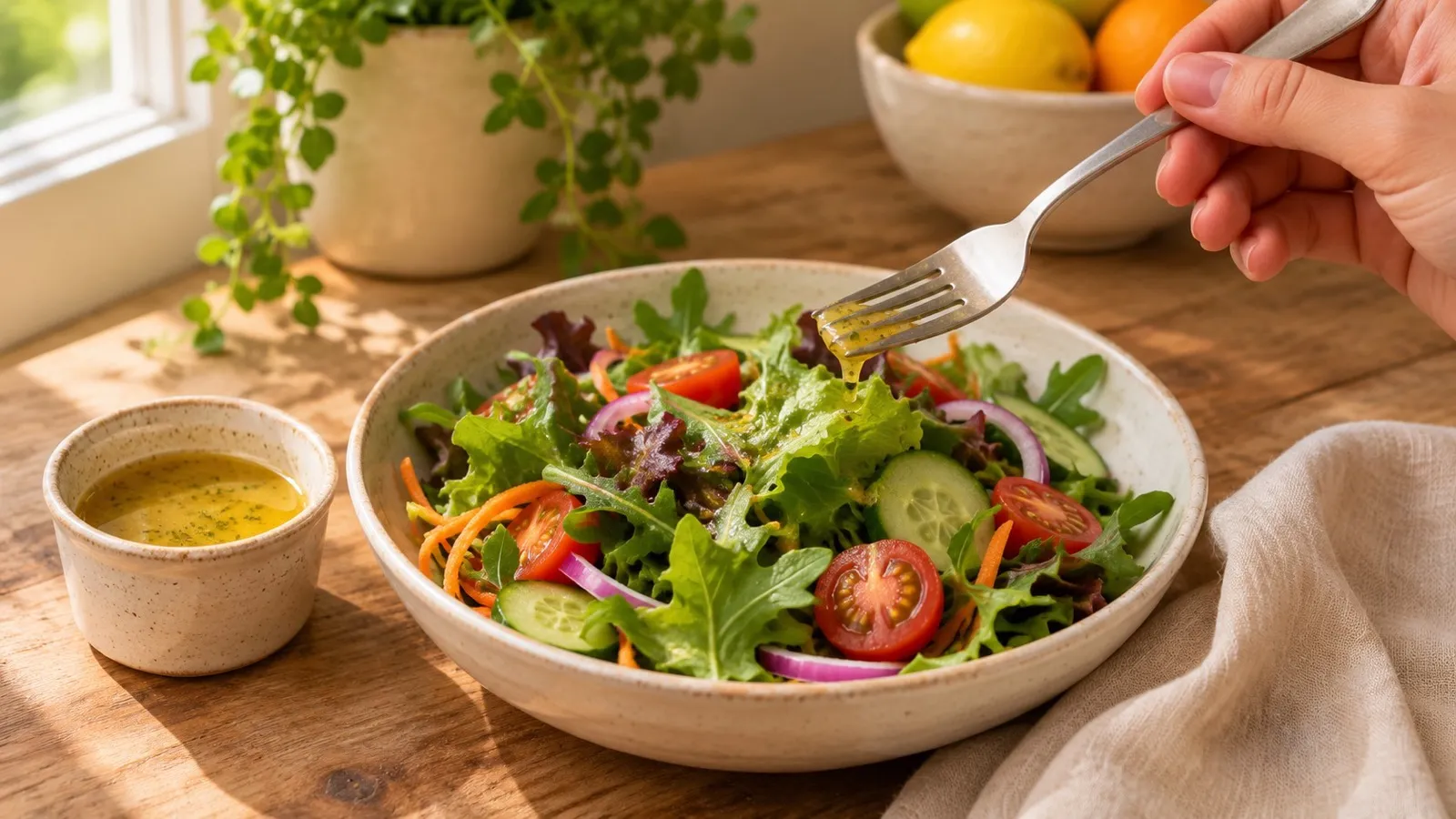
The salad arrives looking almost architectural: greens stacked high, chicken balanced across the top, tomatoes arranged around the edge. Beside it sits a small plastic cup of dressing. You pour a thin line over one corner, eat, add another splash, and stop when the salad tastes right. The cup is still more than half full when the plate is cleared.
A menu entry often describes the salad as sold. Your lunch, however, was the salad as eaten. The difference is sitting in that little cup.
This is one of the easier restaurant estimates to improve because the uncertain ingredient stays visible. You do not need to know the chef’s recipe or identify every seed in the dressing. You need a reasonable estimate of how much left the cup.
Keep the dressing separate in the entry
Start by treating the salad and the dressing as two parts. If the restaurant publishes nutrition information for the base salad and the dressing separately, use those values. If its total includes the full cup, subtracting a precisely guessed amount is not automatically better; first confirm what the published number covers.
When the menu gives no detail, record the salad components you can identify and add a comparable dressing entry for the amount you used. Match the style as closely as practical. A creamy dressing, an oil-based vinaigrette, and a thin citrus dressing are not interchangeable just because they arrived in identical cups.
The goal is not to reverse-engineer a restaurant formula from appearance. It is to avoid logging a full portion of an ingredient when most of that ingredient went back to the kitchen.
Estimate what left, not what remained
If the cup has a marked volume or the restaurant states its size, use that as your starting point. Suppose you can see that roughly one quarter of the dressing is gone. Record about one quarter of the full amount. The fraction matters more than inventing a millilitre value the cup cannot support.
When there is no size information, a familiar kitchen spoon can anchor the estimate. Think about how many spoonfuls you poured, not how deep the remaining dressing looks in a tapered cup. Restaurant cups are often narrower at the bottom, so half the height may not mean half the volume.
You can also pour in stages on purpose. Add a little, toss the part of the salad you plan to eat, and decide whether you need more. This is not a diet trick or a rule about how much dressing belongs on lunch. It is simply a way to keep your portion observable. Once the dressing coats every leaf, the cup can no longer tell you what you used.
Tossing changes the visual clue
Dressing clings unevenly. Some remains on the cup, some stays on the fork, and some pools at the bottom of the bowl. A scale can make the estimate better at home: weigh the cup before and after pouring, using the same lid setup, and the difference shows how much left the cup. At a restaurant, that level of measurement is usually neither available nor necessary.
Look at the bowl when you finish. If a visible pool remains, you did not necessarily eat everything you poured. If the greens are lightly coated and the bottom is dry, the amount that left the cup is a reasonable proxy for the amount eaten. Write a short note when the distinction is obvious, such as “used about a third; some left in bowl.”
Do not apply the fraction to the entire salad. Leaving half the dressing does not mean you ate half the chicken or greens. Adjust the component whose evidence you have.
Published restaurant numbers need headings
Restaurant nutrition pages vary. One listing may include dressing, another may offer several dressings as add-ons, and a third may calculate the salad without any dressing even though a cup arrives automatically. Read the item description, serving details, and any customization notes before using the number.
If the restaurant provides a build-your-own calculator, select the components you actually ordered. Remove ingredients you skipped and choose the dressing separately if the tool allows it. Published information is useful, but only after you align it with the food on the table.
For an independent café with no nutrition page, choose a comparable reference and keep the estimate broad. The cup gives you portion evidence, not the exact composition. A precise-looking total based on the wrong kind of dressing is weaker than a rounded estimate based on the right category.
Use the leftover cup as a quick experiment
At home, save one clean restaurant cup and fill it with water to the level where the dressing started. Pour the water into a measuring spoon or place the cup on a scale before and after. Then repeat with the level that remained. This gives you a rough sense of the cup’s capacity and shape without pretending water has the same nutrition as dressing.
You only need to do this if these cups appear often in your meals. The point is to create a familiar visual reference: a quarter cup used, half a cup used, or roughly one spoonful. Next time, the container will look less mysterious.
The useful question at the end of lunch
Before the tray disappears, look at the cup and ask: how much did I actually pour? Then look at the bowl and ask whether much of it stayed behind. Those two observations are enough for a practical entry.
Takeout meals invite all-or-nothing logging because they arrive as named menu items. Yet the separate cup is an invitation to be more accurate without doing more work. It preserved the part you did not eat.
PixNutri’s guide to tracking calories from a photo can help you identify the rest of the meal. Photograph the cup beside the salad before eating and again afterward if the amount matters. The two images tell a clearer story than the polished menu photo ever could.
There is also a useful choice at ordering time. Asking for dressing on the side is not only about using less; it keeps the portion observable. If the kitchen normally tosses the salad, the published restaurant value may be the best available reference. If the cup arrives separately, you gain evidence about what was offered and what remained. Record that evidence without turning the meal into a contest over the smallest possible amount. The right portion is the one you chose and ate; the cup simply helps you describe it.
Written by the PixNutri Editorial Team. PixNutri provides general information, not medical advice. Learn how we work: Methodology · Nutrition sources · Editorial policy
Spotted a factual error? Report it to our editorial team. We review every report and update the page if needed.
