
Everyone took a slice. The slices weren't equal.
The pizza reaches the table already cut. One slice is broad enough to fold. Another is a narrow wedge with a heavy border of crust. Someone chooses the...
By PixNutri Editorial Team · Published November 23, 2026 · Last updated November 23, 2026 · 5 min read
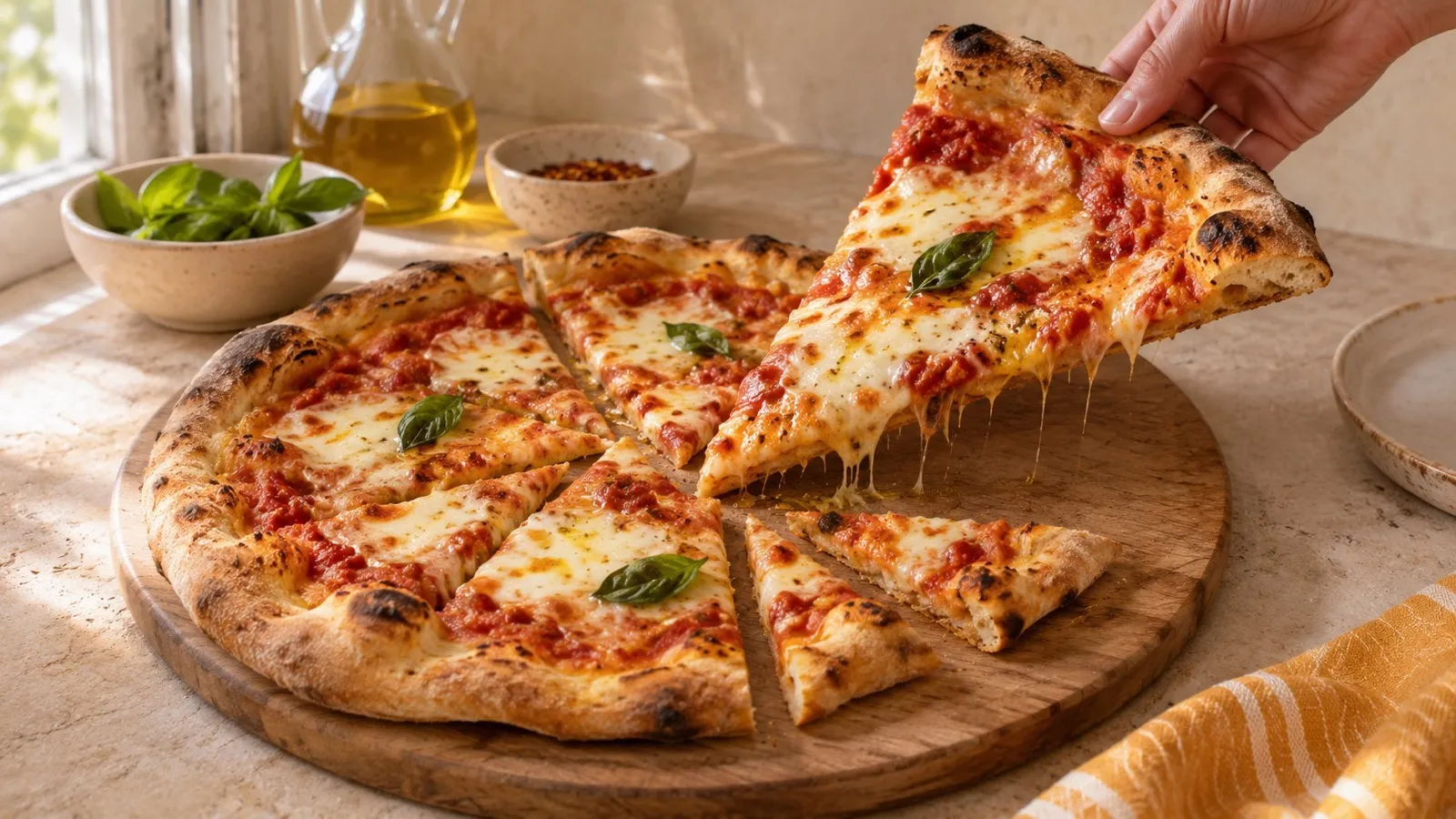
The pizza reaches the table already cut. One slice is broad enough to fold. Another is a narrow wedge with a heavy border of crust. Someone chooses the piece with the most mushrooms. Someone else takes two small slices and calls it the same as one large one. By the end, everyone has eaten “a slice,” but nobody has eaten quite the same portion.
Counting pieces works when pieces are genuinely comparable. Hand-cut food often is not. The useful move is to notice when the piece count has stopped describing the portion and switch to a better reference.
Start with a share of the whole
If you know the nutrition for the entire pizza, pie, loaf, or frittata, estimate your slice as a fraction of the whole. A genuinely even cut into eight pieces makes each piece about one eighth. When the cuts wander, compare the angles at the centre rather than the width of the crust alone. The narrow point tells you how much of the circle the slice occupies.
That works best when the food is distributed fairly evenly. A pizza with cheese and sauce across the whole surface is easier to average than one with a pile of sausage on two slices and bare cheese on the others. A pie with a consistent filling is easier than a tart whose fruit has slid to one side.
If the toppings differ visibly, separate what you can. Use the slice’s share for the base, sauce, and cheese, then adjust for a topping that clearly belongs to one part. You do not need to count every mushroom. You are correcting the part of the average that is obviously wrong.
Weight helps, but only with the question it can answer
At home, weigh the finished food before serving, then weigh your slice. If your piece is a certain share of the finished weight, it is reasonable to start with the same share of the recipe total. This method automatically handles uneven cuts better than piece counting.
It does not automatically handle uneven composition. A crust-heavy slice may weigh the same as a cheese-heavy slice while carrying a different share of the ingredients. The weight tells you the portion of finished food. The recipe average tells you what that portion would contain if the batch were reasonably uniform.
That limitation is not a reason to abandon the method. It is a reason to describe it honestly. “About this share of the pizza” is a good estimate. “Exactly this share of every ingredient” may not be.
Restaurant slices have another reference
For a chain restaurant, check whether nutrition is listed per slice and how many slices the restaurant assumes for that pizza size. A slice from a pizza cut into six is not the same unit as a slice from the same pizza cut into eight. Read the serving description with the number.
For an independent pizzeria, the menu can still help. The diameter, crust style, and toppings narrow the comparison. Choose a reference that resembles what you ate rather than the first result called “pizza slice.” A thin, wide slice and a compact deep-dish piece solve different hunger and different estimation problems.
If you share several pizzas, take a quick photo before the table gets rearranged. The whole pizza provides scale and shows the original cuts. A close-up of the single slice may hide whether it was one sixth or one tenth of the pie.
Two small slices are not automatically one large slice
People often compress a meal into familiar language: two little pieces, one normal serving, half a slice. Those phrases are useful memories, but they need a reference. Put the pieces side by side mentally or in a photo. Together, what fraction of the original circle did they cover?
The crust can distort that judgment. Two narrow slices contain two outer crust sections, while one broad slice of the same central angle contains one continuous crust arc. If you leave the crusts, the amount eaten changes again. Record the pizza you ate, not simply the pieces that reached your plate.
When crust is left behind, avoid subtracting the same fraction from every topping. What remains is mostly dough. A rough adjustment to the base is more defensible than reducing the entire slice by twenty percent because twenty percent of its weight stayed on the plate.
Cut with the future entry in mind
At home, a few seconds before cutting can save several minutes later. Mark the centre, make cuts through opposite sides, and rotate the food for the next cut. If people want different portions, that is fine; weigh the pieces or name them as different fractions instead of calling them equal slices.
For a batch you expect to eat over several days, record the finished weight and recipe total. Then each piece can be estimated by weight without needing the original shape. This is especially useful after the first serving, when the remaining food no longer looks like a whole circle.
If presentation matters more than measurement, cut freely and use a broad estimate. Tracking should support the meal, not turn the table into a geometry exam.
A simple practice for the next shared dish
Before anyone serves themselves, notice the whole. Count the intended pieces, look at whether the cuts are even, and identify any toppings or fillings clustered in one area. When you choose your slice, decide whether “one of eight” is an honest description or merely the label everyone is using.
If it is close, use it. If it is clearly larger, smaller, or compositionally different, adjust the fraction or weigh it. Save the detail for the meals where the difference is visible.
You can build the whole recipe in PixNutri’s recipe collection and use the finished batch as your reference. The important part comes before the arithmetic: a slice is a shape, not a standard serving.
Rectangular foods need the same attention in a different geometry. A tray bake cut into rows can produce large corner pieces, narrow edge pieces, and central squares with no crust. Count the grid only after checking whether rows and columns are evenly spaced. If the pan was cut into twelve intended pieces but one row is visibly wider, “one of twelve” is a label for the plan, not necessarily the piece on your plate. Weight or area can provide a better starting point, while visible frosting, crust, or toppings explain where the average may drift.
Written by the PixNutri Editorial Team. PixNutri provides general information, not medical advice. Learn how we work: Methodology · Nutrition sources · Editorial policy
Spotted a factual error? Report it to our editorial team. We review every report and update the page if needed.
