
The lid came off and lunch got harder to guess
The office refrigerator has done what office refrigerators do best: turned three different lunches into a row of anonymous containers. One has a blue lid,...
By PixNutri Editorial Team · Published November 23, 2026 · Last updated November 23, 2026 · 5 min read
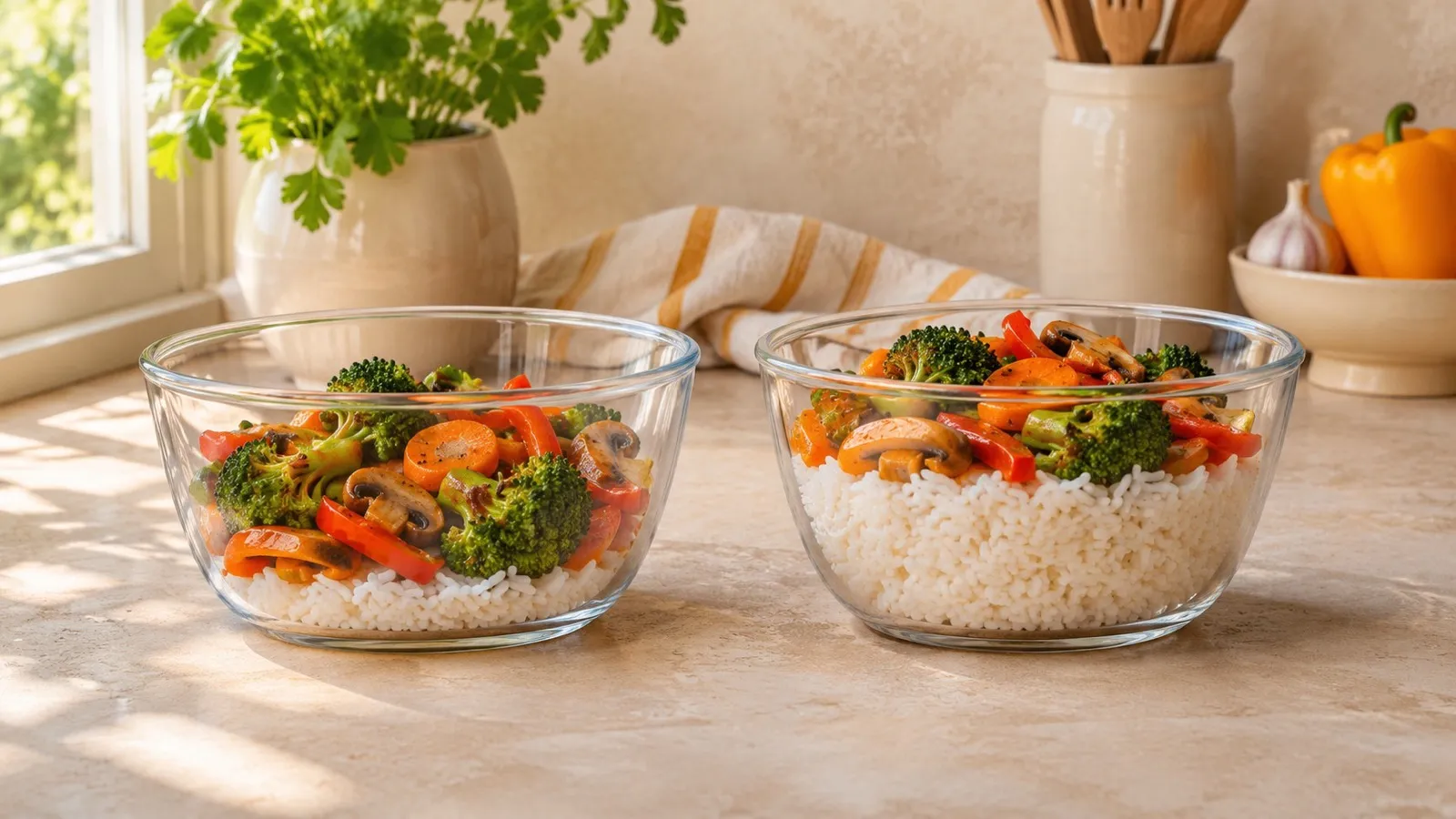
The office refrigerator has done what office refrigerators do best: turned three different lunches into a row of anonymous containers. One has a blue lid, one has no lid at all, and one is covered with a plate because its owner forgot the matching top. You recognise the curry in the open container as yours. What you no longer recognise is the amount.
When you packed it, the container itself was part of the clue. You knew which box you used, how full it looked, and perhaps how much the whole thing weighed. Once the lid came off and the food was stirred, those quiet reference points disappeared. Lunch did not become impossible to record. It simply moved from “known portion” to “portion that needs a fresh estimate.”
That distinction matters. A food diary is more useful when it preserves the quality of the information instead of pretending every meal arrived with the same certainty.
Let the container do some of the remembering
The easiest fix happens before the refrigerator door closes. Weigh the empty container once and write its weight on a small label underneath. Then, when you fill it, weigh the container with the food. Subtract the container weight and you have the amount of food you packed.
You do not need to repeat the empty-container measurement every morning. A durable label turns the box into a simple measuring tool. If you own several identical containers, check them before assuming they weigh exactly the same. Small differences may not matter for an ordinary lunch, but knowing which number belongs to which box prevents a false sense of precision.
The lid deserves a decision too. Weigh the empty container and the filled container in the same state: both with the lid or both without it. A lid that appears in only one measurement becomes part of the food by accident. This is the sort of mistake that looks like careful tracking because a scale was involved, yet the two measurements were never comparable.
When the lid is already gone
At lunchtime, work with what remains. If the curry came from a homemade batch whose finished weight and ingredients you recorded, weigh the portion in a clean bowl or on a plate after zeroing the scale. Use that weight as a share of the finished batch, provided the curry was mixed well enough for the average to make sense.
If you cannot weigh it, look at the container before transferring the food. Its width and depth offer a rough volume reference. A broad, shallow layer is not the same as a narrow container filled to the top, even when both are casually described as “one box.” Avoid turning that visual estimate into an overconfident number. Choose a sensible amount, record it, and move on.
For a lunch made of separate components, estimate those components separately. A box with rice on one side and chicken on the other is not a uniform batch. The missing lid may hide the fill line, but it does not erase the visible boundary between foods. Ask how much rice is there, how much chicken is there, and whether the sauce was packed separately or poured over everything.
The best clue may be yesterday’s kitchen
Reconstruct the packing moment instead of staring harder at the food. Did you divide one pot between two lunchboxes? Did you put dinner on the table first and pack what remained? Did you use the same serving spoon you always use? Each memory narrows the estimate in a way the open container cannot.
This is especially useful when someone else moved the lunch or replaced the lid. The portion itself may be unchanged even though its appearance is less familiar. If you know you split a well-mixed batch evenly between two boxes, each box still represents about half of what you set aside. The missing top affects your confidence in identifying the container, not necessarily the portioning method.
Be careful with leftovers from a shared meal. “What was left” is not automatically your portion. Someone may have taken another spoonful after you packed lunch, or the last scoop may have contained more solids than the first. If that happened, use a rough estimate and keep the uncertainty visible in your notes.
Build a label that answers tomorrow’s question
A date tells you whether lunch is still appealing. A portion label tells you what is inside. For homemade batch meals, the most useful label can be remarkably short: the food name, the packed weight, and perhaps the recipe or batch name you used in your diary.
“Lentil curry, 340 g, Sunday batch” gives future you three ways back into the meal. You can find the recipe, scale the batch value by weight, and distinguish it from the similar-looking curry you made last month. If you freeze it, the label survives the long gap between cooking and eating, when visual memory is least reliable.
Do not put nutrition totals on the lid alone if lids travel between containers. Put the identifying information on the container or use a label that stays with the food. The most carefully calculated number is useless when it migrates to somebody else’s soup.
A practical lunchbox routine
Choose one container you use often. Weigh it empty in the state you normally pack it, label that tare weight underneath, and keep a small roll of removable tape near the food scale. When you pack a batch meal, record the food weight on the tape. If the meal has distinct parts, write the amounts that matter most rather than forcing the entire box into one number.
At lunch, compare the label with what you actually eat. If part of the meal comes home, adjust the relevant component. If you finish it, the morning measurement is enough. The routine adds seconds when the clues are strongest and removes guesswork when you are hungry in front of an open refrigerator.
You can use PixNutri’s food logging guide to turn that portion into a consistent entry. The lid may still disappear. Your useful information does not have to disappear with it.
One final distinction helps when several people use the refrigerator. Identification comes before estimation. Make sure the food is actually yours before applying your recipe and portion label. Similar curries can contain different ingredients, and an unfamiliar lid may have been placed on the wrong box. A name, date, or colour mark on the container solves that problem more reliably than recognising lunch by sight. Once identity is secure, the tare, packed weight, and recipe can do their work.
Written by the PixNutri Editorial Team. PixNutri provides general information, not medical advice. Learn how we work: Methodology · Nutrition sources · Editorial policy
Spotted a factual error? Report it to our editorial team. We review every report and update the page if needed.
