
The scale weighed the bone, too
The drumstick sits on the scale as one neat object. The database entry, however, may describe cooked edible meat. The display can be perfectly accurate...
By PixNutri Editorial Team · Published November 23, 2026 · Last updated November 23, 2026 · 5 min read
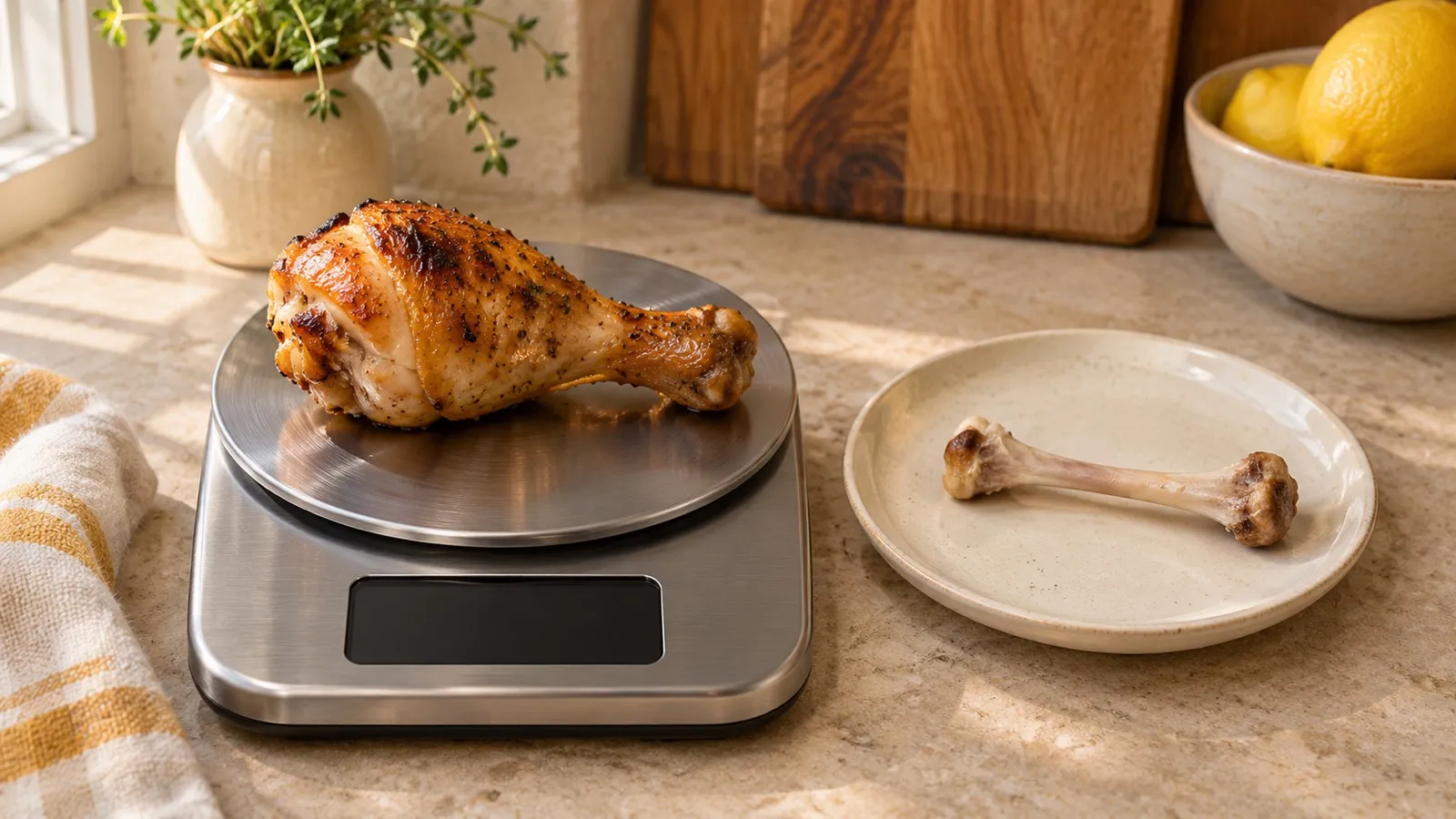
The drumstick sits on the scale as one neat object. The database entry, however, may describe cooked edible meat. The display can be perfectly accurate and still answer the wrong question because bone, skin, and meat are different parts of that object.
That small mismatch is the whole story. Food logging becomes frustrating when a correct-looking number describes a different object, unit, or portion from the one in front of you. The answer is rarely to collect more decimals. It is to slow down for one useful comparison: what exactly did the number describe, and what exactly did you eat?
Start with the scene, not the database
Before searching for a better entry, describe what happened in plain language. In this case, the practical move is to match what is on the scale to the exact description of the food reference. That sentence is more useful than a long list of near-matching search results because it identifies the missing information.
This is also where memory tends to simplify the meal. By evening, a person may remember “yogurt,” “chicken,” or “a snack” and forget the package size, the discarded bone, or the extra scoop. A quick note made while the food is still present can preserve the detail that matters. It need not be a complete diary entry. A weight, a photograph of the label, or five words about what was left can be enough.
The aim is not to turn lunch into a laboratory exercise. It is to catch the one distinction that would otherwise force you to guess later. Entries may differ by raw or cooked state, meat only or meat and skin, and edible portion or whole item. Once you see that distinction, you can choose an estimate that is honest about what you know.
Put the numbers on the same basis
If the whole piece is weighed before eating, weighing the clean bone and other inedible remains afterward can help estimate the edible amount.
The calculation only works when its pieces share a meaning. Grams of edible meat should be paired with a reference for edible meat. Millilitres consumed should be paired with a value per millilitre or scaled from a clearly stated volume. A package total should be used for the fraction of that package actually eaten. When those meanings do not align, arithmetic can make the answer look more certain without making it more correct.
Try saying the units out loud as a check: “calories per 100 grams, multiplied by grams eaten, divided by 100.” If the sentence suddenly changes from cooked to raw, from one product to another, or from a serving to a whole package, stop there. The problem is not the multiplication. It is the reference.
This habit is especially useful when two numbers disagree. Convert them to the same basis before choosing between them. If they then agree, the mystery was formatting. If they still disagree, compare the current package with the database record and prefer the source that most directly describes the food in your hand.
Use one anchor you can trust
Read the preparation and edible-portion words before accepting the first search result.
An anchor is not meant to prove every detail of the meal. It simply keeps the estimate connected to something observed. For a homemade recipe, the anchor might be the finished batch weight. For a packaged food, it might be the net quantity and current nutrition panel. For a plate, it might be the weight of one component before the others cover it.
Choose the anchor that is easiest to collect at the moment when it is available. The empty package is useful before it reaches the bin. The scale is useful before sauce is added. The recipe total is useful before people take different second helpings. Waiting until the end often leaves you with more work and less evidence.
If collecting the anchor would interrupt the meal, keep the estimate broad. A rough entry that accurately reflects uncertainty is more useful than an exact-looking value assembled from assumptions. You can still record what you ate and move on.
What the shortcut cannot tell you
Every shortcut has a boundary. Here, entries may differ by raw or cooked state, meat only or meat and skin, and edible portion or whole item. Knowing that boundary prevents the method from claiming more than it measured.
For example, a total difference on a shared container tells you how much the group removed, not how much each person ate. A barcode identifies a database record, not necessarily the latest recipe. A food photograph can preserve composition while losing depth. A batch average describes a representative share better than a portion that has visibly separated.
These are not reasons to abandon the shortcut. They are reasons to add one sentence of context. “Shared between four, my share uncertain” is useful. “Used noodles and one sachet, left the oil” is useful. “Last scoop, mostly raisins” is useful. The note keeps tomorrow’s reader, including you, from treating an estimate as a measurement.
Make the next meal easier
The best logging habit is often a preparation habit. A precise weight only becomes useful when the reference describes the same thing. It solves the question at the point where the answer is still visible.
Try the method once, then decide whether it earns a place in your routine. If the measured result is close to your usual estimate, you may be able to reuse that estimate for ordinary portions. If it differs, you have identified the specific situation worth checking again. Either outcome saves attention because you are no longer measuring everything indiscriminately.
PixNutri’s food logging guide explains how to combine labels, weights, recipes, and reasonable estimates without pretending that every meal offers perfect data. The same principle applies here: capture the strongest fact available, match it to the right reference, and keep the remaining uncertainty visible.
The next time this scene appears, do not begin with a search box. Begin with the food, the package, or the container in front of you. Ask what changed between the number you have and the portion you ate. That one question usually points to the simplest useful action.
After dinner, the bone left on the plate can be weighed separately, giving the edible portion a concrete boundary instead of a guess.
Written by the PixNutri Editorial Team. PixNutri provides general information, not medical advice. Learn how we work: Methodology · Nutrition sources · Editorial policy
Spotted a factual error? Report it to our editorial team. We review every report and update the page if needed.
