
The jar was easier to weigh than the spoon
The toast pops up while you’re still looking for something small enough to sit on the scale. You find a saucer. By then you already have peanut butter on...
By PixNutri Editorial Team · Published November 23, 2026 · Last updated November 23, 2026 · 5 min read
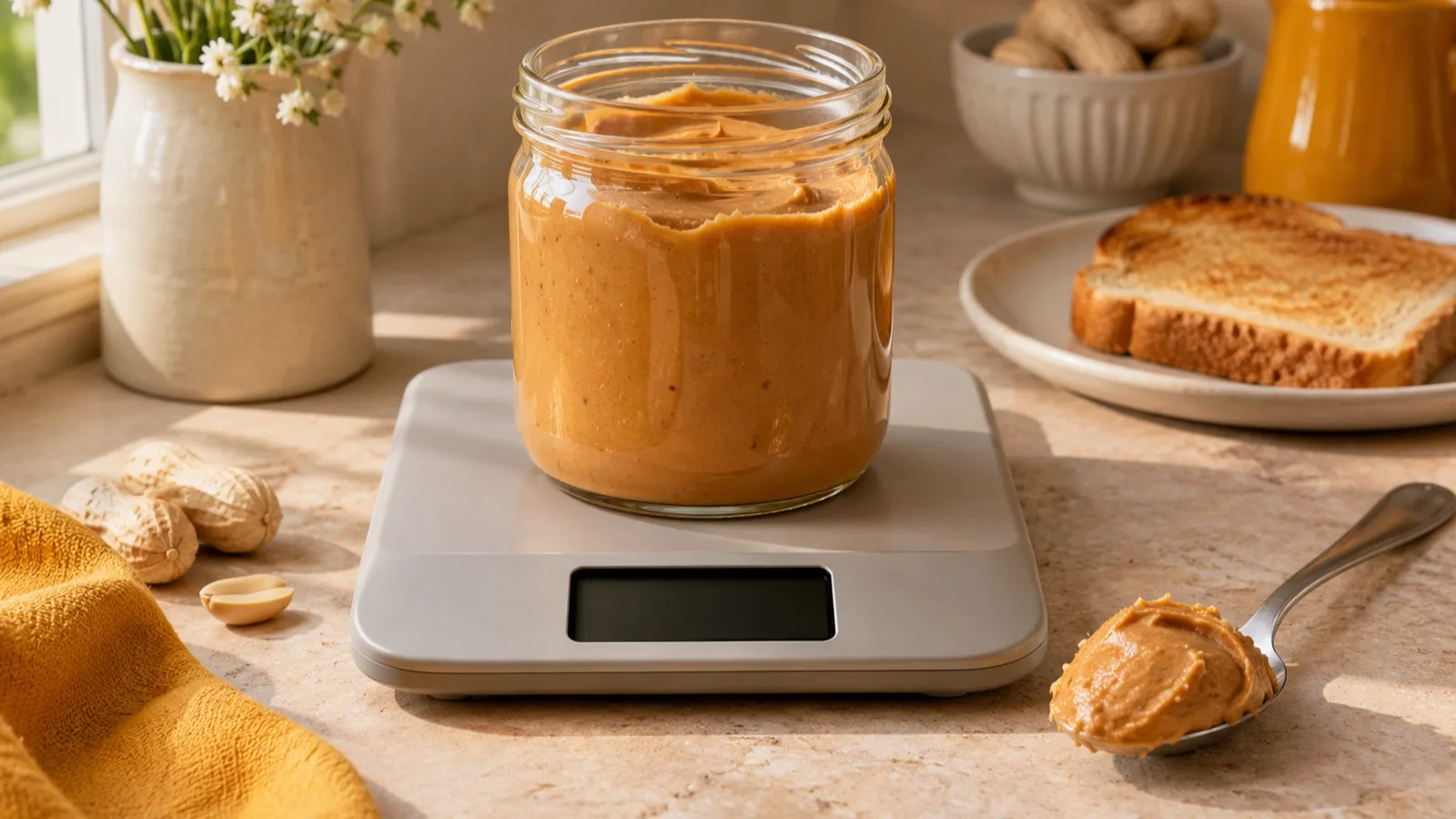
The toast pops up while you’re still looking for something small enough to sit on the scale. You find a saucer. By then you already have peanut butter on the knife, so the saucer is about to join the knife, the plate and the cutting board in the sink. All to find out what you meant by “a spoonful.”
There’s another object on the counter that can answer the question. The jar.
It already holds the ingredient. It’s flat on the bottom. And whatever you take out will show up as a difference between two readings. The only little adjustment is to weigh it before you start spreading.
Start with the jar as you found it
Put the jar on the scale. Write down the weight or leave the display where you can see it. Take the amount you want and spread it on breakfast. Put the jar back on the scale, with the lid in the same state as before. If the first reading included the lid, the second one should too.
Suppose it read 412 grams at the start and 389 grams at the end. In that example, 23 grams left the jar. You can also zero the scale with the jar on it, then put the jar back after taking some out. Some scales will show a negative reading. I’d use two ordinary readings if the scale turns off quickly or resets when the object comes off. There’s less to remember while the toast is hot.
Now look at the knife. If you’ve scraped the scoop onto the bread and there’s only a thin smear left, you have an estimate that corresponds closely to what you served. If there’s still a visible clump, put it on the toast or account for what you didn’t eat. The scale measured what left the jar. That includes whatever is still on the knife.
You could also weigh the toast before and after spreading. That’s a good option if you’ve got the plate on the scale already. The jar method earns its place when the food is going straight into something you can’t easily weigh, like a blender full of ingredients or a bowl you’ve carried to the other end of the counter.
The spoon still gets a vote
If you always use the same spoon, it’s tempting to assume you always serve the same amount. Picture the scoop you take when you’re nearly out of peanut butter, compared with the rounded scoop you dig out of a just-opened jar. You might call them both a spoonful. The spoon is the same. What sits on it can change.
Try it once when the jar is full and again when you’re scraping the sides. The home experiment doesn’t need a tidy conclusion. You might discover that your usual scoop is pretty consistent. That’s useful if you want to reuse the entry. You might discover that the size changes enough that you’d rather measure it on the days you make a noticeably different serving.
If the label lists a value for a serving, check what that serving weighs. Suppose the panel gives 190 calories for 32 grams. A 23-gram portion would come to roughly 137 calories using that example label. If the panel uses 100 grams as the base, divide your portion by 100 before multiplying. The gram weight you measured and the gram weight on the label give you a common unit, even if your spoon looks nothing like the one you imagined when you read the serving description.
When two people reach for the same jar
There’s a small trap with a jar on the breakfast table. You weigh it, make your toast, carry it to the table and come back to the scale. In the meantime, someone else has put peanut butter in their oats. Now the difference includes both portions.
You can do the second reading before you hand the jar over. If that didn’t happen, use the combined amount only for what it describes. A shared total is useful for a batch of smoothies everyone will drink. It can’t tell you which person took what from the jar.
There’s a similar distinction if you’re cooking a recipe and add an ingredient in two rounds. Weigh the jar at the beginning and after the last addition if you want the total used in the recipe. If someone uses it between those moments, take separate readings around each addition. The amounts still add up without requiring a special measuring spoon.
What else belongs on the scale?
Tahini is a natural candidate. So is honey, if you drizzle it directly from the jar into a bowl. Try it with a thick sauce you add while cooking. The method works best when the container fits on the scale and you can keep everything else the same between readings.
It matters more when the difference is large enough for your scale to show clearly. If the display jumps in whole grams and you’re trying to measure a tiny dab, two readings may leave you with more rounding than you care about. For a normal scoop it’s easier to see what moved. You can also leave the jar alone and make a rough note if that’s all you need from breakfast.
A practical way to remember the method is to put the jar on the scale while the bread is still in the toaster. Take the first reading, make breakfast, then put the same jar back. No need to transfer a sticky ingredient somewhere else just so you can move it back again.
If several people use the jar between readings, start over. The subtraction can only describe your portion when nothing else has left the container. The same limit applies if you rinse the spoon into a recipe or return an unused scoop to the jar. A simple method stays useful when its boundaries stay visible.
If you’d like to try it on something other than toast, make the peanut butter and banana overnight oats in PixNutri’s recipe collection. The recipe gives you an amount to aim for. Next morning, if you want an extra swirl, you can find out what you actually added without ever putting the spoon on the scale.
Written by the PixNutri Editorial Team. PixNutri provides general information, not medical advice. Learn how we work: Methodology · Nutrition sources · Editorial policy
Spotted a factual error? Report it to our editorial team. We review every report and update the page if needed.
