
The grocery receipt was enough to start reconstructing dinner
Dinner is gone, the packages are in the recycling, and the recipe lived entirely in your head. On the counter is a long grocery receipt: chicken thighs,...
By PixNutri Editorial Team · Published November 23, 2026 · Last updated November 23, 2026 · 5 min read
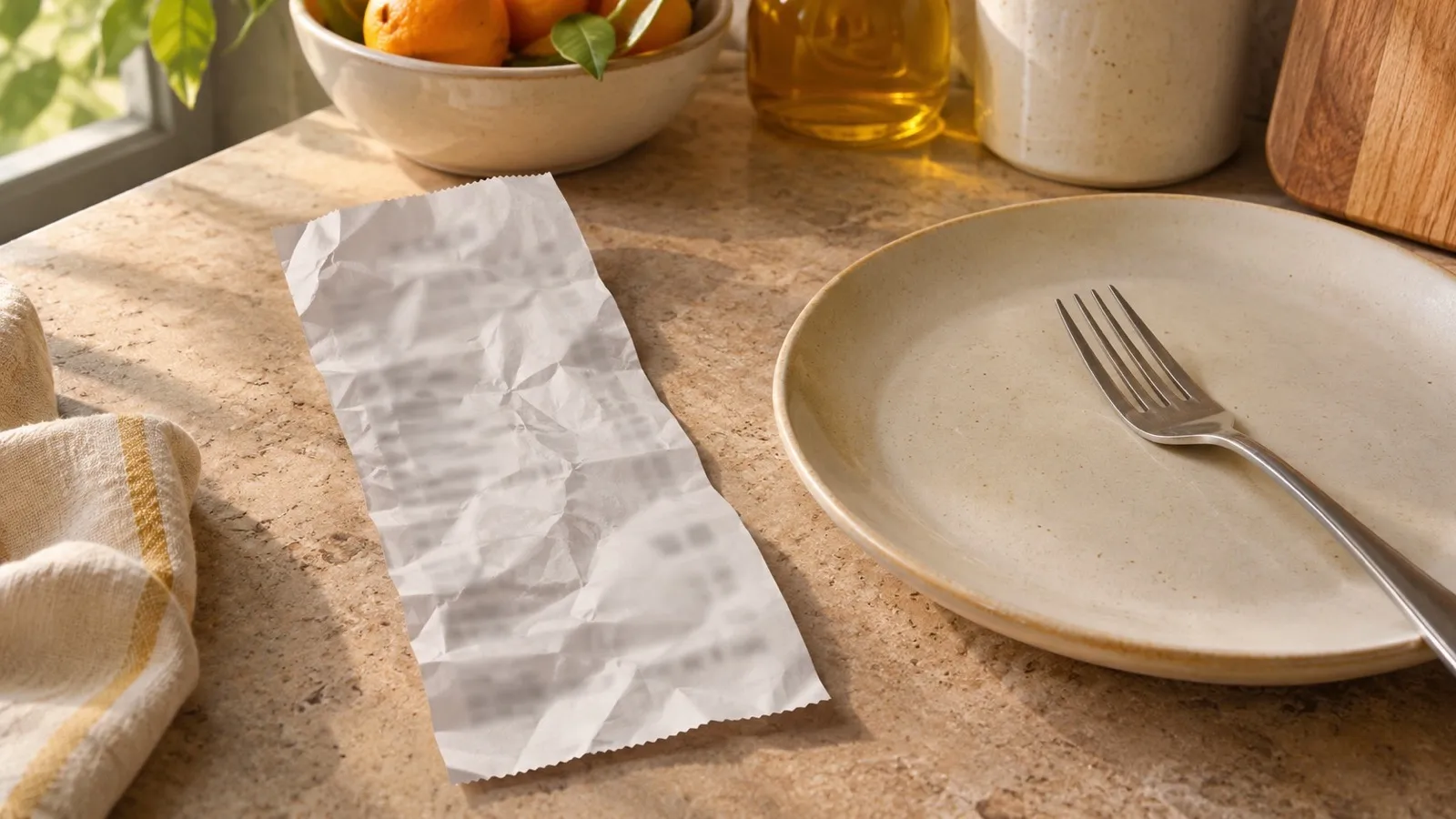
Dinner is gone, the packages are in the recycling, and the recipe lived entirely in your head. On the counter is a long grocery receipt: chicken thighs, peppers, tortillas, yogurt, limes, cheese. It does not tell you exactly what you ate. It does tell you where to start.
A receipt is an ingredient inventory with prices attached. Used carefully, it can recover the shape of a meal without pretending every purchased item entered your plate.
Separate purchased from cooked
Highlight the items that plausibly belonged to dinner. Some groceries went into the pantry, some were for tomorrow, and some were already in the house. The receipt is not the recipe.
Check what remains. If three of eight tortillas are left, the household used five, not necessarily all at dinner and not necessarily all by you. If half the yogurt tub remains and it was used for sauce, the change provides a rough upper boundary. Packaging, leftovers, and the receipt work together.
Write a draft ingredient list with confidence labels: certain, likely, uncertain. Chicken and tortillas may be certain. Oil and spices may be likely because they came from the pantry. Cheese may be uncertain if it was bought but never opened.
Product names can recover hidden details
Receipts vary from descriptive names to cryptic abbreviations. A loyalty account or digital receipt may show the full product, size, and sometimes a link. The package barcode in purchase history can identify the exact yogurt or tortilla when several versions exist.
Use the receipt quantity and package size as a boundary, not as the amount consumed. Buying a 500-gram package of chicken does not prove the whole package went into dinner. Look for raw leftovers, cooked leftovers, or the number of pieces prepared.
For items sold by weight, the receipt can be especially useful. It preserves the purchased weight of produce, meat, cheese, or deli food after the sticker has been discarded. Subtract what remained when a reasonable measurement is available.
Rebuild the cooking sequence
Recall what happened at the stove. Was the chicken fried, baked, or grilled? Did oil go into the pan? Was yogurt mixed with lime for sauce? Did everyone assemble their own tortillas?
The sequence reveals ingredients the receipt cannot. Pantry oil, salt, spices, and water do not appear on today’s transaction. The cooking method also tells you whether some purchased weight was bone, skin, peel, or another part not eaten.
Do not assign exact amounts to invisible ingredients without evidence. If you remember coating the pan but not how much oil, choose a reasonable range or standard cooking estimate and mark it as such. A receipt-supported reconstruction can still contain uncertainty.
Move from household dinner to your plate
Once the batch is sketched, estimate your share. Count the tortillas you ate, pieces of chicken, spoonfuls of sauce, and toppings. Shared ingredients rarely divide perfectly by the number of diners.
If everyone built their own tacos, component-level recall is stronger than taking one quarter of the entire grocery bill. One person may skip cheese, another use extra sauce, and leftovers may remain. Record the plate you assembled.
For a mixed casserole or stew, estimate the finished batch and your portion as a fraction or by cooked weight if leftovers can still be measured. The receipt helps with ingredient identity; the serving dish helps with distribution.
Prices are usually the least useful nutrition clue
Do not infer quantity from price unless the receipt also states weight or count. Promotions, loyalty discounts, and regional prices make cost a poor portion measure. A high price does not mean a large amount, and a discounted family pack may be far bigger than dinner.
Use the item code, package description, count, and sold weight. Ignore subtotal arithmetic unless it helps distinguish two similar products. The receipt was designed for payment, so extract only the fields that answer food questions.
Tax categories are not reliable nutrition categories either. They vary by jurisdiction and tell you nothing about how much you ate.
Save the reconstruction as a recipe only when it is one
If you can identify the ingredients and amounts with reasonable confidence, create a recipe for the batch and note that it was reconstructed. Add the finished weight if leftovers allow you to measure it. This makes the estimate reusable if you eat the remainder tomorrow.
If major quantities remain unknown, keep the components as a meal entry rather than turning guesses into a permanent recipe. A reconstructed dinner can be useful without becoming an authoritative formula.
Take a photo of the receipt or keep the digital version with your note. Product names may be clearer now than they will be after the memory fades.
Make the next receipt more powerful
After shopping, put meal-specific ingredients together on the counter and take one quick photo before cooking. During preparation, record the amounts of the major ingredients and any cooking fat. The receipt then confirms products while the photo and scale confirm use.
You can assemble those details in PixNutri’s recipes. Tonight’s receipt could not tell the whole story, but it recovered the cast: chicken, peppers, tortillas, yogurt, limes, and cheese. That was enough to begin asking the right questions.
Online orders can offer even stronger evidence. The order history may show product photographs, package sizes, substitutions, and quantities. Check substitutions carefully: the receipt may list what was delivered, while the original cart shows what you intended to buy. Dinner used the delivered product.
Cash purchases at a market may provide only broad lines such as “produce.” In that case, use the receipt mainly for timing and total visit context. The vegetables in the refrigerator and your memory of the stall are better identification clues.
Keep privacy proportional. A food reconstruction does not require uploading or permanently storing a receipt with payment details. Extract the product information you need, crop or redact sensitive fields if saving an image, and discard it when the entry is complete.
Restaurant receipts can play the same role, but watch for grouped names such as “lunch special” or modifier codes. The menu may be needed to unpack them. Tips, taxes, and service charges add cost without adding food; shared checks add food that may belong to someone else. Start from the line items, then assign only the dishes and shares you ate.
If the receipt contradicts memory, investigate the mismatch rather than choosing whichever produces the cleaner entry. Perhaps an item was substituted, shared, returned, or purchased for later. The contradiction is a clue about the meal’s story, not a reason to force the receipt into a recipe.
Written by the PixNutri Editorial Team. PixNutri provides general information, not medical advice. Learn how we work: Methodology · Nutrition sources · Editorial policy
Spotted a factual error? Report it to our editorial team. We review every report and update the page if needed.
