
You can weigh dinner and still have to make an estimate
The plate is on the scale. The rice weighs one amount, the chicken another, the vegetables a third. Every display settles into a crisp number. Then you...
By PixNutri Editorial Team · Published November 23, 2026 · Last updated November 23, 2026 · 5 min read
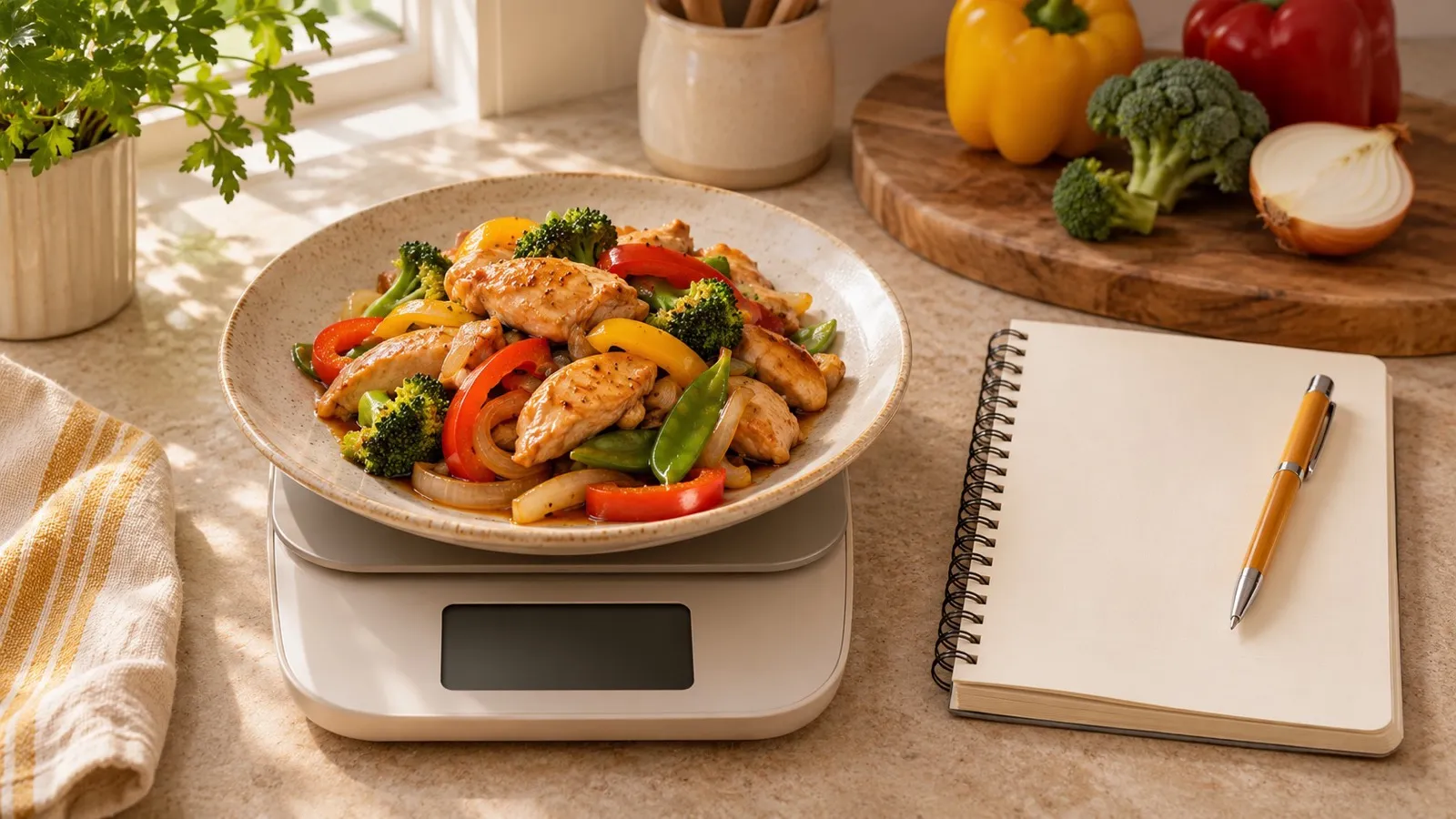
The plate is on the scale. The rice weighs one amount, the chicken another, the vegetables a third. Every display settles into a crisp number. Then you look at the casserole dish, the oil left in the pan, the sauce recipe you changed midway, and the chicken piece with a bone.
Weighing dinner answers important questions. It does not answer every question. A scale measures mass. It does not identify ingredients, determine edible portions, distribute a mixed recipe, or know what stayed behind.
A weight needs a description
“180 grams” is incomplete until you attach it to food in a particular state. Is it cooked rice or dry rice? A whole drumstick or edible meat? Drained beans or beans with liquid? A finished stew or the raw ingredients before cooking?
Match the weight to a nutrition reference that describes the same thing. This simple alignment prevents many large errors. The scale can be perfectly accurate while the entry is conceptually wrong.
Write the state into saved names: cooked, raw, drained, with bone, without skin, prepared with milk. The description keeps the measurement usable after the plate is gone.
Mixed dishes require a model
When you weigh a bowl of chilli, the scale tells you how much finished chilli is there. To estimate its nutrition, you still need the recipe total and finished batch weight. Your bowl’s share of the batch weight becomes a model for its share of the ingredients.
That model assumes the dish is mixed reasonably well. If one bowl contains mostly beans and another mostly meat, equal weights do not contain equal shares of every ingredient. Stir before serving or portion major components separately when the difference matters.
The estimate is still useful. Its strength comes from making the assumption visible, not from pretending the scale eliminated it.
Bones, peels, and packaging travel across the scale
A whole chicken piece includes bone. A banana weighed with peel includes something you did not eat. A yogurt pot includes plastic. If your reference describes edible food, the weight should describe edible food too.
Weigh before and after when practical. The difference between the whole piece and the leftover bone can estimate edible amount, provided both readings use the same plate and account for anything else left behind. For fruit, weigh the edible portion directly or subtract the peel afterward.
Container tare matters for takeout and leftovers. Use a known empty container, transfer the food, or subtract a verified tare. Guessing the box weight is still an estimate; label it accordingly.
Cooking fat rarely announces where it went
You can weigh the oil poured into a pan, but not all of it necessarily reaches your plate. Some remains on the surface, some clings to utensils, and some stays with portions eaten by other people. A recipe total that includes all added oil gives an upper-bound style estimate unless you account for visible leftovers.
For a shared batch, divide additions using the same model as the food when they are well distributed. For pan-fried pieces, distribution may be uneven. Use a reasonable estimate rather than converting uncertainty into a precise absorption percentage with no evidence.
The scale improves the starting amount. Observation improves the fate of that amount.
Restaurant food begins with unknown recipes
Bringing a portable scale to dinner would not reveal the recipe. A measured restaurant pasta portion still contains unknown amounts of oil, cheese, sauce, and pasta. Weight can narrow the portion, while the menu, published nutrition, and visible ingredients identify composition.
If the restaurant publishes nutrition for the item and serving, use it as the primary reference and adjust for the portion actually eaten. If not, choose comparable prepared-food entries and preserve uncertainty in your notes.
The strongest clue is sometimes not mass. A separate dressing cup, a labelled bottle, or a menu description may answer the ingredient question more directly.
The number can be exact and the estimate still broad
A scale reading of 247 grams may be exact to the device’s displayed resolution. If the food reference is generic or the recipe share uneven, the nutrition estimate remains broader. Keep the measured number; interpret the output according to the weakest meaningful assumption.
This is not failure. Measurement reduces one source of uncertainty. It does not need to eliminate all uncertainty to be worthwhile.
Focus effort where it changes the decision. Correct the wrong food state, omitted sauce, or inedible weight before worrying about a one-gram fluctuation. Large conceptual matches matter more than tiny display changes.
Build an evidence ladder
For each meal, use the strongest evidence available. A current product label and measured amount are strong for packaged food. Weighed ingredients and finished batch weight are strong for home recipes. Published restaurant data can be strong when it matches the exact item. Photos, menus, receipts, utensils, and memory fill the gaps.
No single method must carry the entire meal. The rice may be weighed, the chicken estimated from edible portion, and the sauce taken from its label. Combine them transparently.
PixNutri’s methodology explains how nutrition sources and portion inputs work together. Use the scale as one witness among several. It is a very good witness to mass and a silent witness to everything else.
That is the practical end of the series: weigh what you can, describe what you weighed, model what you must, and keep the remaining uncertainty honest. Dinner does not have to become exact to become more knowable.
There is a sensible stopping rule. Once the food identity, state, major ingredients, and consumed portion are aligned, ask whether another measurement would materially improve the record. Weighing a sauce cup before and after may help; chasing moisture from a few leaves probably will not. Effort should follow uncertainty that matters.
Repeatability often matters more than isolated perfection. If you use the same reasonable method for a weekly recipe, comparisons across those meals become more meaningful. Record the method so future you can reproduce it: ingredients weighed raw, batch weighed cooked, portion weighed after stirring.
And when the evidence is weak, say so in a note. “Restaurant estimate,” “bone weight subtracted,” or “oil amount uncertain” preserves the boundary of knowledge. Honest estimates are not second-class data. They are the normal way real meals become usable records.
The scale earns its place by improving the questions you can answer, not by removing judgement from the kitchen.
Written by the PixNutri Editorial Team. PixNutri provides general information, not medical advice. Learn how we work: Methodology · Nutrition sources · Editorial policy
Spotted a factual error? Report it to our editorial team. We review every report and update the page if needed.
